Abstract
Laser NDT methods based on interferometric
imaging, primarily holography
and shearography, have seen
growing acceptance since the
mid 1980's. With the large increase
in the use of composite materials
and sandwich structures, the
need for high speed, large area
inspection for fracture critical,
sub-surface defects such as
disbonds, delaminations, sheared
core or non-visible damage in
aircraft, missiles and marine
composites led to broad acceptance
of laser based NDT methods.
Laser NDT Methods employing
holography and shearography
imaging interferometers compliment
UT, Thermography and other NDT
methods as highly developed,
mature and cost effective technology.
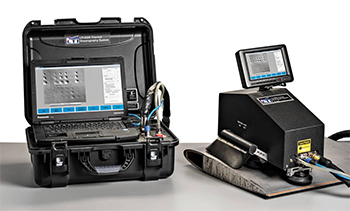
Typical
shearography camera systems,
include a built-in laser illumination
source, the shearing interferometer,
image processing computer and
remote
controls. These systems may
be used
alone with thermal or vibration
stress or
in test chambers with vacuum
stress
shearography techniques.
As with all NDT methods, strengths
and weakness must be completely
understood, applications qualified
through PoD verification with written
procedures and rigorous training
for operators and engineers alike.
Once qualified for a particular
application, holography and shearography
systems can operate with extraordinary
efficiency reaching through-puts
from 25 to 1200 sq. ft per hour,
2.5 to 120 times the inspection
rate for ultrasonic C-Scan. As these
technologies become more widely
known, commercial applications in
aerospace, electronics, marine composites,
high-performance tires and medical
devices have greatly increased.
In 2005, Laser Methods have reached
a fundamental milestone with inclusion
of Holography and Shearography in
ASNT TC-1A for Level III Certification.
This paper will present an over
view of Laser NDT Method applications
in aerospace, electronics and marine
composites where they serve as highly
effective, fully integrated industrial
process controls, improving manufacturing
quality while reducing costs.
Background
Laser interferometric imaging
NDT techniques such as holography
and shearography have seen dramatic
performance improvements in the
last decade and wide acceptance
in industry as a means for high-speed,
cost effective inspection and
manufacturing process control.
These performance gains have been
made possible by the development
of the personal computer, high
resolution CCD and digital video
cameras, high performance solid-state
lasers and the development of
phase stepping algorithms. System
output images show qualitatively
pictures of structural features
and surface and subsurface anomalies
as well as quantitative data such
as defect size, area, depth, material
deformation vs. load change and
material properties. Both holography
and shearography have been implemented
in important aerospace programs
providing cost effective, high-speed
defect detection.
Holography
images test part responses to
changes in load showing the, as
well as part movement. Holography
using continuous wave lasers and
video frame rate data acquisition
require vibration isolation usually
in the form of air supported isolation
tables. Coupled with ultrasonic
vibration excitation of the test
part, holographic systems in production
provide very high-resolution images
of disbonds in small complex shaped
components, such as turbine aircraft
components and medical devices.
Shearography
NDT systems use a common path
interferometer to image the first
derivative of the out-of-plane
deformation of the test part surface
in response to a change in load.
This important distinction is
responsible to two key phenomena.
First, shearography is less sensitive
to the image degrading effect
of environmental vibration. Shearography
systems may be built as portable
units or into gantry systems,
similar to UT C-Scan systems,
for scanning large structures.
Second, the changes in the applied
load required to reveal subsurface
anomalies frequently induce gross
deformation or rotation of the
test part. With holography, several
important test part stressing
techniques, such as thermal and
vacuum stress, create gross part
deformation. Defect indications
may be completed obscured by these
translation fringe lines. Shearography,
on the other hand is sensitive
only to the deformation derivatives
and tend to show only the local
deformation on the target surface
due to the presence of a surface
or subsurface flaw.
Shearography, in particular offers
unique and proven defect detection
capabilities in aerospace composites
manufacturing. Shearography images
show changes in surface slope,
in response to a change in applied
load. Shearography whole field,
real-time imaging of the out-of-plane
deformation derivatives is sensitive
to subsurface disbonds, delaminations,
core damage, core splice joint
separations as well as surface
damage. Secondary aircraft structures
have long used composite materials.
The drive for better vehicle performance,
lower fuel consumption and maintainability
are pushing the application of
composites and sandwich designs
for primary structures as well.
Faster and less expensive inspection
tools are necessary to reduce
manufacturing costs and ensure
consistent quality.
Fig.1.
Schematic diagram of a
Michelson Type
shearography interferometer
observing a flat metal
plate with a 4-inch diameter
machined flat-bottomed
hole. A center load change
on the plate provides
a
variable deformation,
observed on the computer
monitor in real-time.
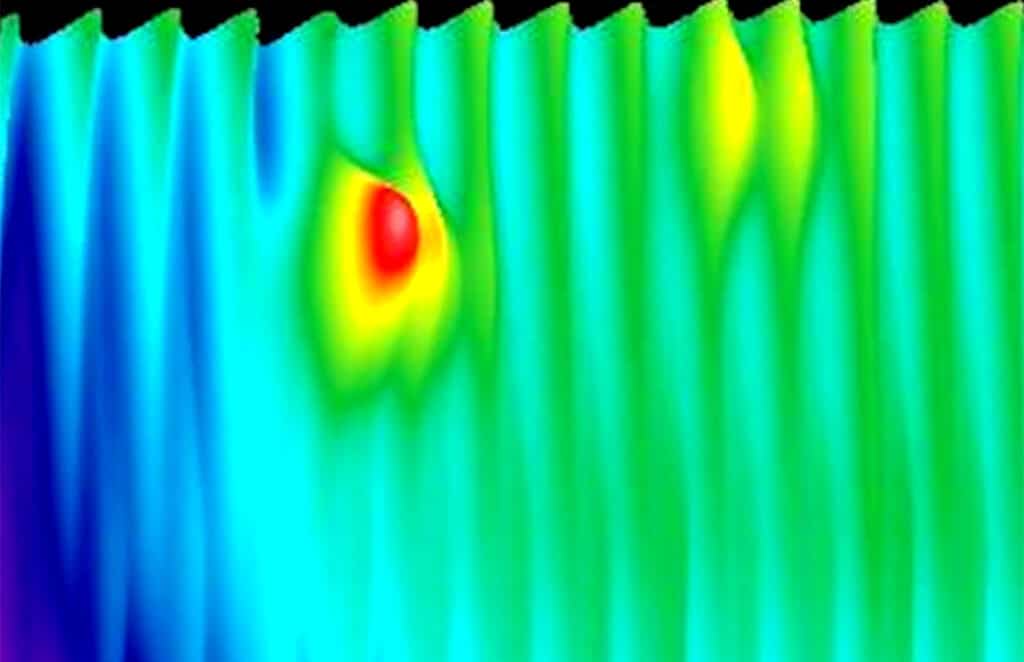
Fig.2
A phase map shearogram
with horizontal shear
vector yields a fringe
pattern showing the first
derivative of the out-of-plane
deformation, ?w/ ?x.
Using an unwrapping algorithm,
the image at right
shows the positive (white)
and negative (black)
slope change. The metal
plate with a 4.0-inch
diameter flat-bottomed
hole was deformed by 7.0
microns.
Shearography The
concept of using a common
path interferometer to image
test part deformation derivatives
to overcome the effects
of environment vibration
and loss of the defect signal
due to gross part deformation
, as seen with thermal stress
holography, was first introduced
by Butters et al (1971)
and reduced to practice
by Nakadate et al(1985).
Shearography
cameras generally use
a Michelson type interferometer
with two essential modifications.
First, one mirror may
be precisely tilted to
induce an offset, or sheared
image, of the test part
with respect to a second
image of the part. The
sheared amount is a vector
with an angle and a displacement
amount. The shear vector,
among other factors, determines
the sensitivity of the
interferometer to surface
displacement derivatives,
Fig 1.
The two laser speckle
images of the test part,
offset by the shear vector,
interfere at every paired
point over the surface
in the field of view.
The single frequency laser
light from the two sheared
images of the part is
focused onto the CCD camera
array of photosensitive
pixels. Light from pairs
of points in each sheared
image interfere. Each
video frame, comprised
of the complex addition
of these two sheared images
can be subtracted from
a stored reference image.
The absolute difference
yields a fringe pattern
observed on the monitor.
The second mirror in the
Michelson interferometer
may be phase stepped using
a piezoelectric device
and the images combined
to create a phase map.
Further processing using
any number of unwrapping
algorithms may be used
to generate fringe free
images of local surface
deformation derivates,
Fig 2.
In
practice each step in
creating a shearogram
is performed automatically
using image-processing
macros constructed by
combining each processing
function in a sequence.
Shearography system operators
perform a test with a
single keystroke. Portable
shearography systems using
voice recognition commands
have been built further
freeing the operator from
system functional operations.
Fig.
3 The integrated image of
the shearogram in Fig 2. shows
the out-of-plane deformation.
Integrated images of deformations
derived from shearography
data are free errors due
to gross object deformation
or translation.
Quantitative
Shearography Measurements Precision
calibration of the shearogram
image scale (pixels/inch)
and the shear vector allow
further processing of shearography
data to determine defect indication
dimensions, area and the deformation
of the material. The digital
measurement of the deformation
derivative may be integrated
to show the shape of the target
surface deformation as well
as the magnitude of the deformation
at any location, as in Fig
3. Shearography can be used
to measure the deformation
response of a structure to
an applied load and as a means
for deriving material properties.
Shearography
NDT Systems Shearography
NDT systems are either portable,
for on vehicle or structure inspection
or fixed production systems using
gantries to scan large panels or
structures. As with all laser devices,
exposure of the operator to laser
emissions must be tightly controlled
and in compliance with State and
Federal laws. Laser interlocked
to test cell doors or vacuum attachment
features are an
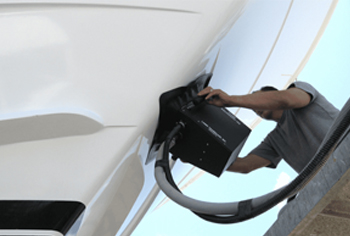
Portable Shearography NDT Systems Portable
shearography systems generally
are either tripod mounted or attached
in some manner to the test object
(Fig.5).
Portable system use laser diodes
and various means such as vacuum
changes, thermal flux or vibration
to stress the object surface to
detect subsurface anomalies.
Shearography
techniques using portable systems
are excellent for engineered repairs
in composite laminates. Fig. 6
shows a repair to an aircraft
laminate with far side, bonded
stringers (diagonal linear features).
The repair uses scarf plies built
up thicker than the original material;
hence the signal from the stringers
appears to disappear under the
repair. Visible also are areas
of porosity (circled in white).
Test time is 15 seconds.
Portable shearography
systems have seen extensive use
in aerospace and marine composite
inspection since the introduction
of the first systems in 1989.
More than 170 composite boats
and ships, including the Swedish
Visby Naval Corvette ships measuring
73 meters. Portable shearography
systems also recently were used
to inspect the composite wind
fairings covering the full 2,200
ft. length of the Bronx Whitestone.
Fig.
5. Shearography inspection of
composite honeycomb engine reversers
on the Airbus A330 using the
LTI-4200.
The structure is GRP face sheets
with
aluminum core. The inner surfaces
are
coated with a foam fire retardant
material.
Shearography indications in
the sandwich
structure, through the foam
are routine.
Defects indications are verified
with
secondary UT measurements requiring
spot removal of the foam.
Fig.
6 Shearography image of
engineered repair to a solid
laminate
aircraft structure with far
side bonded
stringers. Porosity is circled.
Tripod
mounted shearography cameras,
are used frequently with thermal
stress shearography techniques.
While Thermography is sensitive
to changes in surface temperature
(or the derivatives of the temperature
change), thermal shearography
images changes in the thermal
expansion of a structure. Damage,
disbonds, FOD or delaminations
produce local changes in the coefficient
of thermal expansion.
Thermal shearography is not generally
effected by variations in emissivity
or paint on the test part surface.
Fig.
7. Thermal shearogram of a Global
Hawk aircraft fairing showing
lay-up of the composite material.
Thermal shearography is used for
detection of disbonds and face
sheet delaminations.
Fixed Production Shearography
Systems
First introduced on the USAF B-2
production program, gantry mounted
shearography systems share many
operational features with UT C-scan
systems. These include: teach/learn
part scan programming, electronic
image of the entire part, image
analysis and defect measurement
tools, automated operation. Shearography
system however operate at throughputs
typically in the range of 100
to 500 sq. feet/hour compared
to a typical throughput of 10
sq. ft./ hour for UT C-Scan systems.
In addition, gantries are considerable
less expensive since precision
part contour following is unnecessary.
Currently dozens of these systems
are in operation on aerospace
manufacturing programs
Conclusions
Shearography and holography NDT
methods are mature and cost effective
production NDT methods for many
aerospace applications. Shearography
provides very rapid inspection
allowing immediate feedback for
process controls. Recent inclusion
in ASNT TC-1A will help further
the development of new applications
and methods.